
Written By Donald Leitch and Colin McGugan
Suas Leis a’ Gàidhlig!
If you were walking down the street in Dutton, West Lorne, Rodney or Glencoe in the late 19th century, you might have heard people greeting each other with “Ciamar a tha thu” or Dè tha dol”, with responses of “Tha gu math” or “Chan eil moran”. Many of the residents of these areas had roots in the Highlands and Islands of Scotland, where Scottish Gaelic was the everyday language.
You can still hear the language in Scotland and in parts of Nova Scotia. It has mostly died out in southern Ontario. Language is a part of cultural history, and to appreciate the culture of many of the early settlers in Southwestern Ontario, a knowledge of their language is desirable.
When Scottish settlers arrived in Canada in the 1800s, many of them spoke Gaelic as their first and perhaps only language. Groups of settlers came from the same areas in Scotland and settled close to each other so they could live their daily lives conversing with their neighbours here in Gaelic. Their children grew up speaking it at home, but when they went to school, the use of Gaelic was discouraged or forbidden.
As the Scottish settlers integrated with other English-speaking residents, the language slowly died out. When a Gaelic speaker married a non-Gaelic speaker, the language was not used in the household, and the children probably did not learn it. Up to about 1900 there were still many families that spoke Gaelic at home. Now it would be hard to find a Gaelic speaking household in Ontario. Many peoples’ great grandparents probably knew some Gaelic, but it died out in the 20th century.
GAELIC FROM PAGE 1.
Language is an important part of cultural heritage. Expressions and idioms reflect the history of the speakers. Gaelic has its roots in western Europe and was influenced by the farmers and seafarers that lived in Ireland and Scotland. There are many expressions to describe the weather, as would be expected if you have ever visited that part of the world.
Scottish Gaelic is a Celtic language and is similar to Irish Gaelic and Manx. Gaelic was brought to Scotland by Irish immigrants about 1500 years ago and has evolved since. Norse invaders influenced the language in the western areas of Scotland.
There are many resources available for people who would like to learn more about Scottish Gaelic. https://learngaelic.scot has good resources. Duolingo provides free on-line lessons. The Gaelic College in Cape Breton delivers University level on-line courses for a fee at https://gaeliccollege.edu. Speak Gaelic at https://speakgaelic.scot. The Sabhal Mòr Ostaig on the island of Skye in Scotland https://www3.smo.uhi.ac.uk/gaidhlig/ionnsachadh/ .
While learning Scottish Gaelic may seem intimidating at first, after spending some time on it you will appreciate the sound and cadence of the language. The music and poetry of the Gàidhealtachd is worth exploring, so why not give it a try!
Historic Gaelic Play Draws
Sold-Out Crowds at Tait’s
Corners Schoolhouse
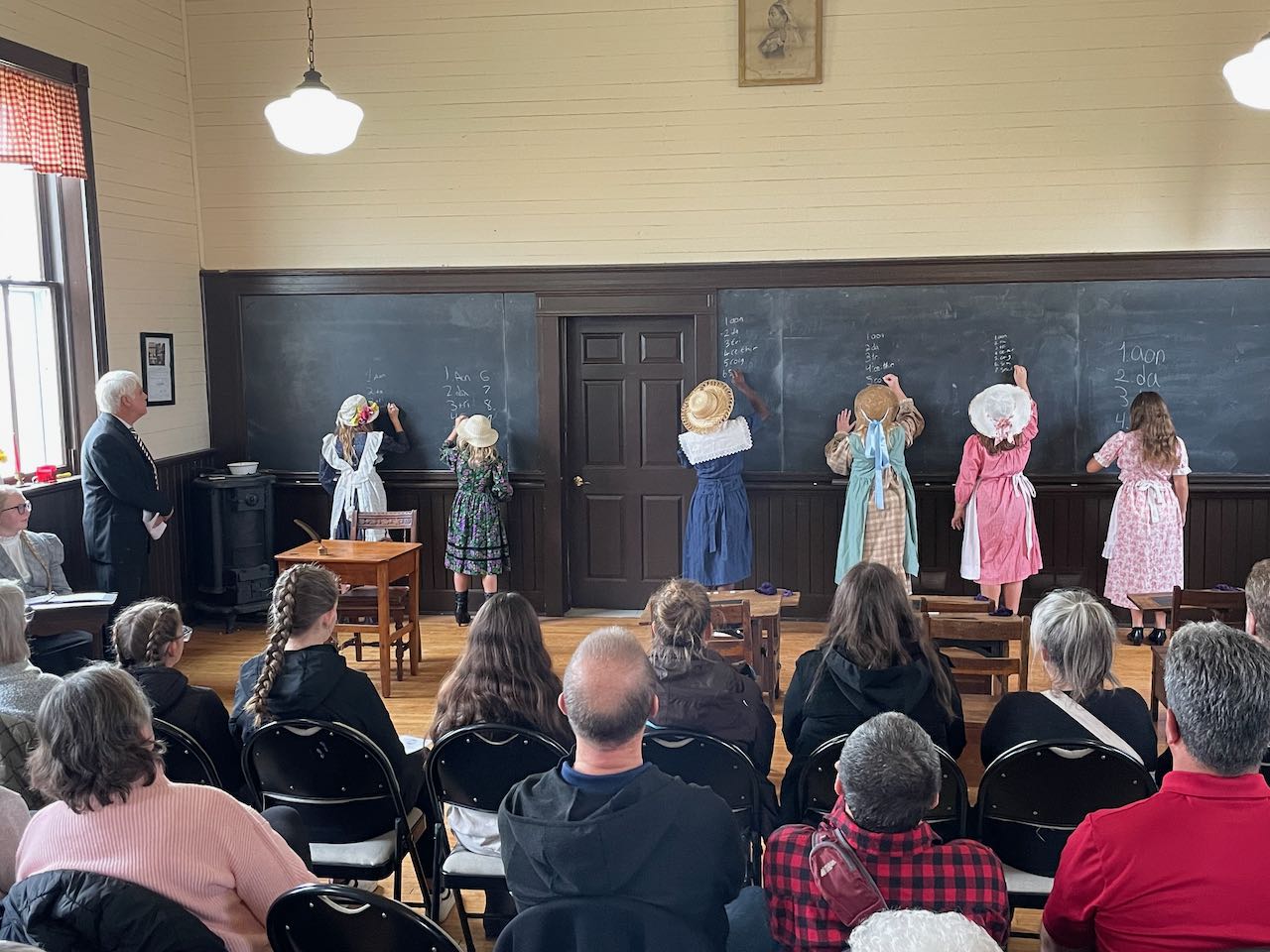
SOUTHWEST MIDDLESEX — A series of three performances of the Gaelic play June Journey / Turas an Ògmhìos, written by local Gaelic scholar Trevor Aitkens and directed by Antje Giles, drew full-capacity audiences at the historic Tait’s Corners Schoolhouse on November 15 and 16, 2025. The event was sponsored jointly by the Glencoe & District Historical Society and the Tait’s Corners Community Group.
Staged inside the restored 1910 one-room schoolhouse, the play offered a historical re-creation of early school life in the area at a time when the Scots Gaelic language—once commonly spoken in parts of Ontario—was rapidly declining. The production featured an ensemble cast of 18 local volunteers, ranging from youth to seniors.
Aitkens, a sixth-generation descendant of Scottish Highland settlers in the Talbot Settlement, has spent more than two decades studying the Scots Gaelic language. His script blends local history with authentic Gaelic dialogue, highlighting the cultural and linguistic heritage once found throughout rural communities in Middlesex County.
Historically, Scots Gaelic was widely spoken across Canada in the 18th and 19th centuries, especially in areas settled by Highland immigrants. By Confederation in 1867, Gaelic was among the most frequently spoken European languages in the country. Its decline accelerated in the early 20th century as government policy discouraged—or in some cases punished—its use in schools.
The Tait’s Corners performances aimed to raise awareness of this history and to encourage renewed community interest in Gaelic culture. Audience members responded enthusiastically, filling all available seats for each performance and participating in post-show discussions about language preservation, family heritage, and the role of local history in community identity.
Cast members: Alyssa Giles, Nathan Reycraft, Trevor Aitkens, Sophia Rodgers, Alexandra Giles, P. Thelma Tangah, Alyssa Vandepol, Kaitlyn Heyda, Jillian Heyda, Amy Giles, Jeff Giles, Ron Hills, Bertha Rose Park, Colin McGugan, Marilyn Dolbear, Donald Neil Leitch, Mary Campbell, Antje Giles